

European tolls: how AS 24 is staying ahead of the game

Across Europe, road toll systems are entering a decisive phase of modernisation, marked by an unprecedented acceleration in the rollout of Global Navigation Satellite System (GNSS) technologies. Driven by national, regional and local authorities, several road networks are currently being overhauled: existing toll domains are being expanded, new ones are being introduced, and above all, legacy technologies such as 2G are gradually being phased out as GNSS becomes increasingly widespread.
The pace of the change may vary, but the direction is clear: ➡ GNSS is becoming the standard for all new toll domains. Some countries have already rolled out a national satellite toll system for HGVs, while others are in the process of finalising the switchover. In the Netherlands, a GNSS system will cover the entire motorway network and some national roads as from 1 July 2026. In France, Alsace, followed by the Grand Est region, is also adopting this approach, particularly on routes with high traffic volumes and significant cross-border traffic.
This change is significant: it directly affects transport operators and toll transactions solution providers. While the EU promotes interoperability through a directive, each country keeps its own rules, tariffs, road coverage, enforcement methods and CO₂-based differentiation. But one thing is clear everywhere: GNSS and 4G are becoming essential requirements for the years ahead.
It is precisely in this changing landscape that AS 24 has been making decisive technological choices since 2022: the bold move to introduce a 4G toll tag with Yunex.
AS 24 looks back at these decisions and their practical impact on transport operators.
As 2G is being phased out across many European countries, including France by the end of 2026, relying on a toll tag based on end-of-life technology becomes a real risk. In particular, if technical migrations cannot be carried out, the tags may no longer be accepted in the countries concerned, which could result in vehicles being immobilised or fines being issued.
Conversely, 4G enables faster, more stable and more future-proof communication between the OBU and toll systems.
Because we anticipated this change four years ago by rolling out the Yunex 4G multi-technology GNSS/DSRC box on a wide scale. This head start has enabled us to add new countries and respond quickly to regulatory changes in a way that is seamless and transparent for customers, for example:
This gives our customers greater peace of mind, as they will not have to change their on-board units in the coming months.
This is also what it means to put the customer at the centre of our decision-making!
Because at the time of the call for tenders, the market had not yet shifted so clearly towards 4G and GNSS, and we made a bold technological gamble: selecting a supplier able to anticipate what was coming and support future GNSS requirements.
Four very concrete points:
This link is obvious: the end of 2G requires a rapid transition to OBUs capable of operating in all new GNSS domains.
With Yunex, we have a solution that is:
This choice limits physical replacements, ensures compliance, and protects our customers from service interruptions.
A bold choice yesterday, and a strategic advantage today for our PASSango offer and the peace of mind of our customers.
Indeed, tolls have been widely covered in the media. We are now officially accredited in the Netherlands, becoming the first provider to obtain this status. This accreditation allow right now our customers to drive confidently within the new Dutch GNSS framework with automatic activation via our 4G OBU and no action required on their side.
At the same time, France is continuing its own transition with the introduction of the first charging measures in Alsace, and then throughout the Grand Est region. Once again, we are preparing to integrate these new toll domains without any material changes for our customers.
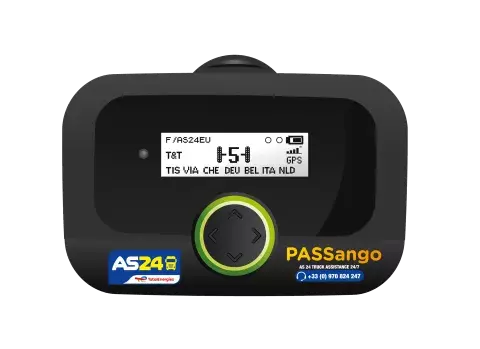
15 countries covered with a single OBU, including the recent addition of Switzerland and the Netherlands
Regular launches of new countries or toll domains
Simple, quick, Plug & Play installation
Fully digital management (activations, OTA updates, a single bill)
Recognised in-house expertise in technical, regulatory and operational matters